FiledISRAELIKFZ684 · OCT 18, 2026, 13:30
Peptide Quality: Significance Of Third-party Validation

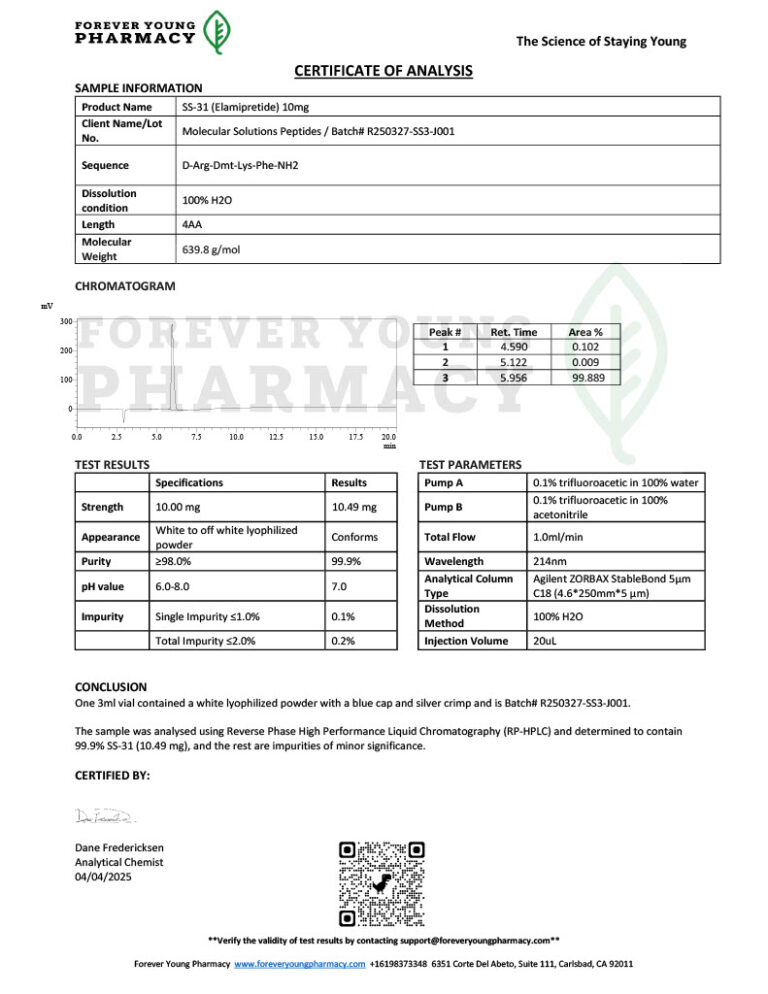
On Peptide Purity Documentation openness remains a vital aspect throughout vendor evaluation. Pureness screening data is frequently summarized within a Certification of Analysis (COA). One usual mistaken belief is that a highly pure peptide will constantly liquify quickly.
Tirzepatide Reconstitution Calculator: Bac Water Quantities & Focus Tables For Lab Research Study
Creative Proteomics gives peptide purity evaluation making use of logical reversed-phase HPLC integrated with mass spectrometry. They supply MALDI-TOF MS and various other mass spectrometry options routinely. Mass spectrometry (MS) validates peptide identification by determining molecular weight. The technique figures out the precise mass of the peptide, which functions as a molecular fingerprint. If the measured mass matches the anticipated mass for your peptide series, you have verification that the appropriate compound exists. And the only method to understand what you're in fact getting is via correct logical testing. Unrefined peptides appropriate for applications where pureness isn't crucial, such as antibody manufacturing or first screening assays where the target peptide just needs to be present, not leading. Mass spectrometry measures the molecular weight of a substance with extreme precision. For peptides, the most common strategies are electrospray ionization (ESI-MS) and matrix-assisted laser desorption/ionization time-of-flight (MALDI-TOF). HPLC divides a blend into its private components based on just how each molecule interacts with a particularly created column. The liquified peptide sample is injected right into a stream of Semax liquid solvent (the mobile phase) that flows with a tube loaded with tiny bits (the fixed stage). Various particles "stick" to those bits with different toughness, so they travel with the column at different speeds.Standard Pureness (≥ 95%)
Is 95% purity good for peptides?
Peptides with an 85% purity level or higher are generally utilized in enzyme assays or organic activity researches. Peptides with pureness more than 95% are exceptional for quantitative analysis.
- Examining uses Inductively Combined Plasma Mass Spectrometry (ICP-MS), which can identify also trace degrees of metals.
- One recorded case entailed a bodybuilder who injected what was identified as Follistatin.
- When reviewing a peptide vendors listing, researchers should prioritize suppliers that offer extensive analytical information.
- A Certification of Analysis (COA) records the logical testing performed on a particular peptide set.
- Peptide pureness screening data are compulsory in preclinical studies and have to be consisted of in investigational new medication (IND) applications and later brand-new medication applications (NDAs).
Certificates Of Evaluation
However these COAs typically come from the vendor's very own screening, creating an obvious problem of passion. Also when suppliers claim third-party testing, confirming those claims needs effort most buyers do not make. Researchers frequently examine mass spectrometry results along with HPLC data to build a much more full understanding of product top quality. As the research study peptide industry remains to grow, understanding how peptide pureness testing works can aid researchers make even more informed sourcing choices and much better evaluate supplier transparency. Contaminations aren't simply inactive fillers; they can proactively disrupt your job. Peptide screening is the set of analytical checks used to review a peptide sample before it is utilized in a study workflow. In functional COA testimonial, the term typically describes purity testing, identification testing, and paperwork testimonial. Purity screening asks how much of the spotted example is the main peptide versus related contaminations. Identification testing asks whether the measured mass or sequence-related evidence matches the intended peptide. Documentation testimonial asks whether the record is batch-specific, traceable, and described enough to be examined. Discover confirmed suppliers using high-purity peptides, clear paperwork, and regular top quality for your speculative requirements. On the other hand, a peptide showing good HPLC purity might have subtly moved mass specification information suggesting an alteration (such as methionine oxidation) that isn't extreme sufficient to create chromatographic splitting up. 98% purity by RP-HPLC is the common benchmark for research-grade peptides and represents a durable degree of pureness for many preclinical research applications. Together with this peptide testing overview, those web pages form the trust-methodology layer behind the item catalog. The US Pharmacopeia takes into consideration 98% the minimum acceptable standard. For accuracy applications, structural biology, or safety-critical usages, focus on 98%+ pureness. The peptide dose chart assumes affordable pureness degrees for accurate application. Peptides like GHK-Cu utilized for skin applications could be applied topically instead of injected. While injection-grade criteria may be much less Analytical Testing critical for topical use, identity confirmation continues to be crucial to make sure the intended substance is being applied.Ends · ISRAELIKFZ684